
Drying of Corrugated Boxes: A Complete Guide
Corrugated boxes are among the most versatile and widely used packaging materials worldwide. From safeguarding fragile goods to transporting bulk consumer items, they play a vital role in logistics and supply chain systems. Their popularity stems from their lightweight design, high strength, cost efficiency, and recyclability.
However, the performance and durability of corrugated boxes depend heavily on one crucial factor — moisture control.
Since paper is the primary component of corrugated packaging, it naturally absorbs and releases moisture from the surrounding environment. Excess moisture can weaken the box’s compression strength, cause warping, or even lead to product damage during storage or transportation. Therefore, maintaining the right moisture balance through effective drying is essential.
Proper drying not only enhances mechanical strength but also improves adhesive bonding, print finish, and overall durability of the packaging.
Understanding Corrugated Boxes
Corrugated boxes are made using two key components: linerboard, which forms the flat outer surfaces, and fluting, the wavy paper layer sandwiched between the liners. This combination gives the box its strength, rigidity, and cushioning ability while keeping it lightweight. The manufacturing process includes corrugating the paper medium, applying adhesive, bonding the layers, printing, cutting, folding, and final shaping. Throughout these stages, moisture is introduced through adhesives, inks, and even environmental humidity. If this moisture isn’t properly removed, it can negatively impact the box’s structural integrity. Since corrugated board is hygroscopic, it naturally absorbs and releases moisture based on surrounding conditions. To maintain performance, the board typically needs a stable moisture level of 8–12%. Excess moisture can weaken the box, while too little can make the paper brittle. This is why controlled, uniform drying is essential—to preserve strength, prevent defects, and ensure the box performs reliably throughout its lifecycle.
Why Drying is Necessary
-
- Strength Retention : Excess moisture weakens fiber bonding, reducing compression and bursting strength and causing box collapse during stacking or transit.
-
- Prevents Warping : Uneven moisture leads to bending or warping, making boxes unsuitable for automated packing.
-
- Better Adhesive Bonding : Proper drying ensures starch or synthetic adhesives form strong bonds; insufficient drying causes delamination..
-
- Improved Print Quality : Moisture affects ink absorption, causing smudging, dull prints, and poor coating adhesion.
-
- Hygiene & Longer Shelf Life : Moisture trapped inside boxes encourages mold and bacteria, risking contamination of food and pharma products.
- Logistics Efficiency : Moisture adds weight, increasing transport cost; well-dried boxes remain lighter and more stable.
Drying Methods for Corrugated Boxes
Different drying methods are used depending on production size, budget, and expected quality. The major methods include:
1. Natural Air Drying
Boxes are kept in open or ventilated areas to dry through ambient air.
Advantages:
1) Very low cost 2) No machinery required 3) Ideal for small-scale or rural manufacturers
Disadvantages:
1) Very slow drying process 2) Depends heavily on weather conditions 3) Results are inconsistent due to humidity variations
2. Hot Air Drying Systems
Boxes move through a controlled chamber with circulating hot air.
Advantages:
1) Much faster than natural drying . 2) Provides uniform, consistent results. 3) Allows control of temperature and humidity.
Disadvantages:
1) High energy usage. 2) Risk of over-drying, causing brittleness.
3. Other Advanced Drying Technologies
These modern methods are used in high-speed or specialized production lines:
1) Infrared (IR) Drying – Uses IR lamps for rapid surface drying. 2) UV Drying – Quick curing of coatings or inks using ultraviolet light.3) Microwave Drying – Offers fast, uniform drying through internal heating of moisture.
Factors Affecting Drying
Several variables determine how effective the drying process will be:
- Ambie nt Conditions : :Temperature, humidity, and airflow greatly impact drying speed. High humidity slows evaporation and delays drying.
- Paper Quality : The GSM and type of liner (kraft, recycled, or virgin) influence moisture absorption. Virgin kraft dries faster, while recycled paper holds more moisture.
- Adhesive & Ink Properties :Starch-based adhesives require longer drying compared to synthetic ones. Water-based inks also extend drying time.
- Board Thickness : Single-wall boards dry quickly, whereas double or triple-wall boards take longer due to higher material thickness.
- Production Speed : High-speed corrugation lines need advanced and efficient drying systems to maintain output quality.
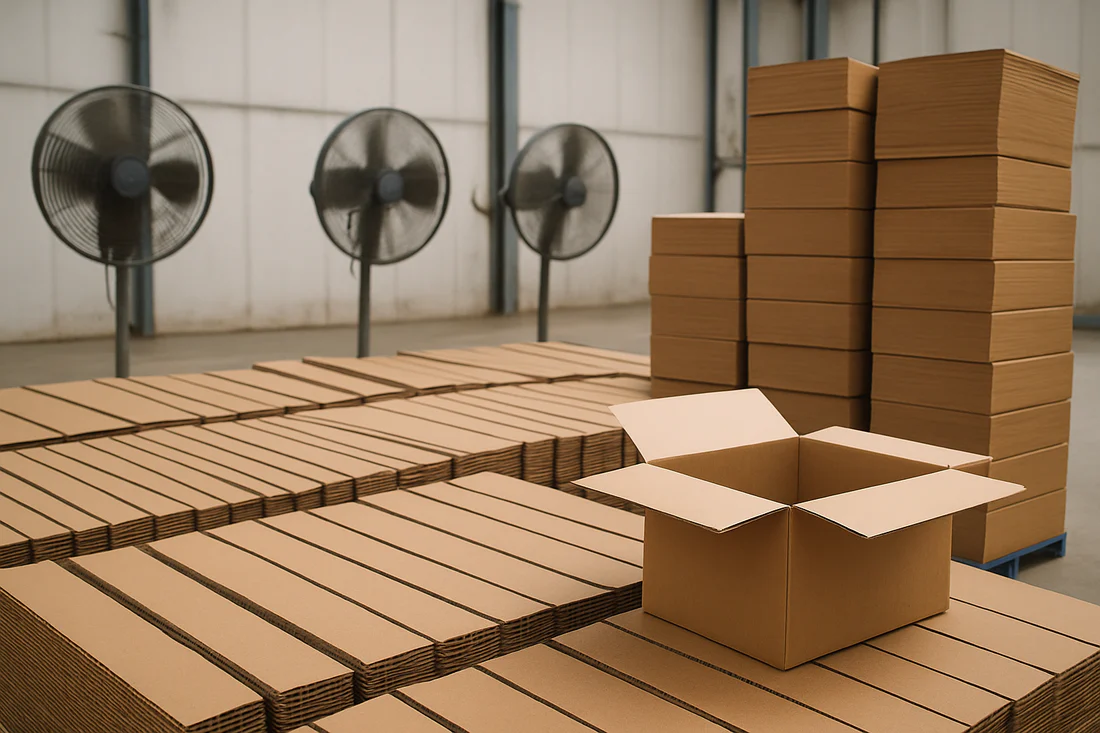
- Stacking & Handling: Tightly stacked boards block airflow and slow the drying process. Adequate spacing helps achieve uniform drying.
Best Practices & Innovations
To overcome these challenges, industries adopt a combination of good practices and innovative technologies:
-
Controlled Drying Rooms : Dedicated rooms with regulated temperature and humidity for consistent results.
-
Moisture Measurement Tools :Digital moisture meters and sensors ensure boxes are dried to the right level.
-
Optimized Airflow Design: Using fans, ducts, and circulation patterns to ensure even drying.
-
Energy-Efficient Technologies: Heat recovery systems, variable-speed fans, and insulation reduce energy use.
-
Automation & IoT :Smart dryers with sensors, automated controls, and AI-based monitoring are being introduced.
-
Sustainable Solutions :Solar-assisted drying and biofuel-powered dryers are gaining popularity.
Conclusion :
Drying plays a vital role in corrugated box manufacturing, as it directly impacts the strength, durability, and overall performance of packaging. Inadequate drying can lead to weakened compression strength, warping, and compromised product protection. With options ranging from traditional air drying to advanced IR, UV, and microwave systems, manufacturers can choose methods based on their production scale and quality needs. Although challenges like energy consumption and environmental concerns persist, adopting best practices—such as continuous moisture monitoring, using neutral pH or moisture-resistant adhesives, incorporating fast-drying additives (especially Dixsons formulations), optimizing airflow, and implementing sustainable technologies—helps achieve consistent and efficient results. As global demand for corrugated packaging grows, manufacturers must balance efficiency, cost, and sustainability. The future of corrugated box drying lies in smarter, eco-friendly technologies that deliver stronger, more reliable, and environmentally responsible packaging solutions.